
10TH ICRN FORUM - Rhine-Ruhr Region, Germany
Thank you!
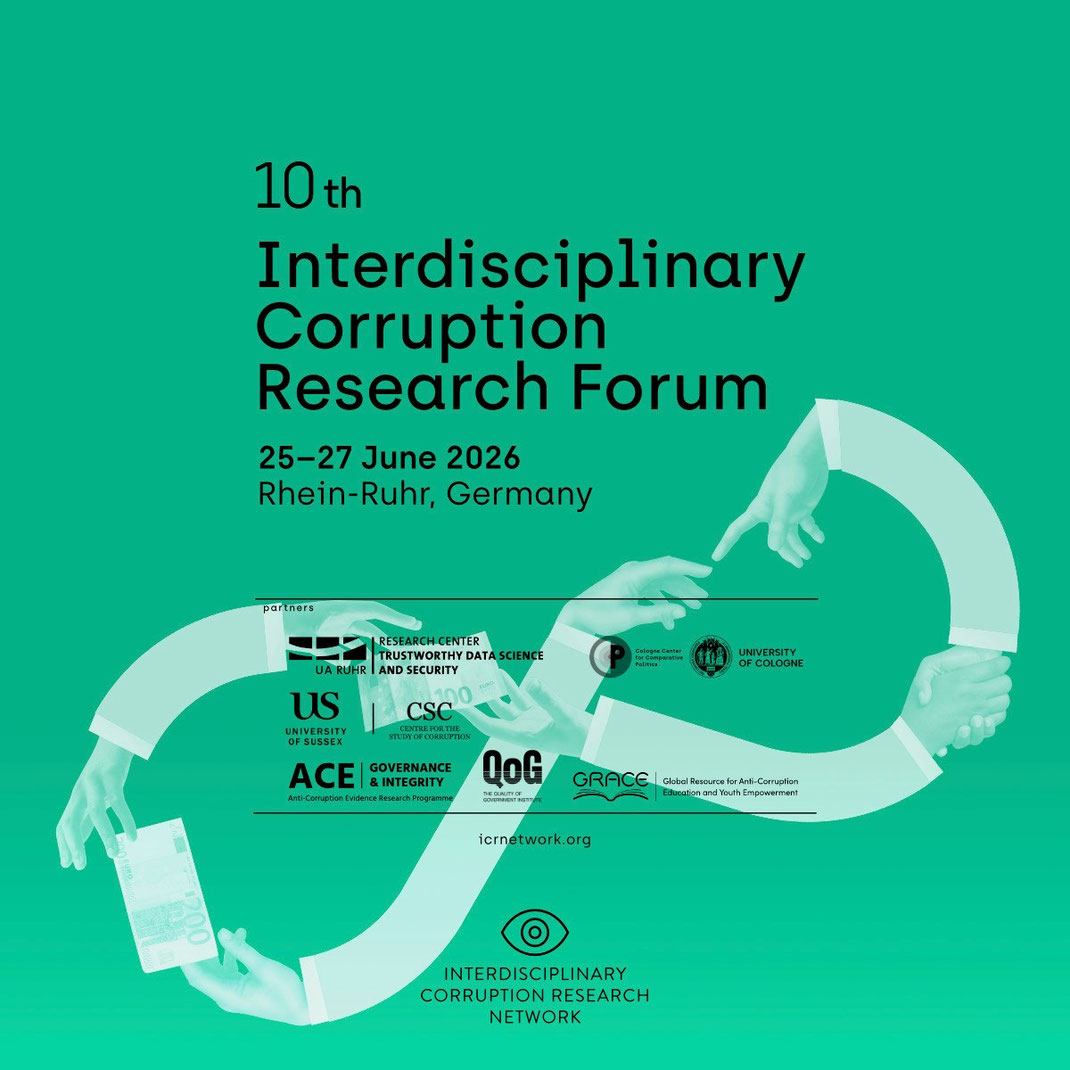
The 10th ICRN Forum 2026, jointly hosted by the Research Center Trustworthy Data Science and Security at the University of Duisburg-Essen and the University of Cologne, has successfully concluded! The event, which took place in Duisburg on June 25-27, brought together motivated and ambitious researchers for three days of inspiring presentations, engaging discussions, and valuable exchanges.
A big thank you to all participants for their excellent contributions and for making this year's event such a success!
We look forward to the 2027 ICRN Forum. Stay tuned for updates!
Key Information about the Forum:
Dates: June 25-27 2026
Venue: Collective.Ruhr, Hafenstraße 2, 47119 Duisburg
Programme: The link is available here.
Keynote Speakers:
Sofie Schütte (U4 Anti-Corruption Resource Centre)
Sofie Schütte is Principal Adviser at U4 Anti-Corruption Resource Centre at Chr. Michelsen Institute in Bergen. She leads U4’s thematic work on corruption and anti-corruption measures in the justice sector, including anti-corruption agencies and special courts, and since 2024 also the thematic work on evaluation and measurement. Over the years as a U4 adviser, Sofie did workshops and short-term assignments in many countries, including Afghanistan, Benin, Bhutan, Cambodia, Indonesia, Kenya, Kosovo, Malawi, Mali, Nepal, South Africa, Tanzania, Thailand, Uganda, Ukraine, and Zambia. In the past, she worked as an adviser for the Partnership for Governance Reform in Indonesia (United Nations Development Program) and as an integrated expert for the Indonesian Corruption Eradication Commission in Jakarta. Sofie holds a Master’s degree in Southeast Asian Studies, Business & Economics, and Sociology from the University of Passau, Germany. In 2012, she completed her PhD on the Indonesian Corruption Eradication Commission at the University of Melbourne.
Jorge Valladares (Transparency International)
Jorge is the Political Integrity Policy Lead at the Transparency International Secretariat (TI-S) in Berlin. Prior to TI-S, he supported transitions to democracy as International IDEA’s Head of the Global Programme on Political Parties (2016-2018) and the Head of Mission to Myanmar (2014-2016), among other roles. His work supported leaders from politics, society, and government to carry out democratic reforms in countries from Latin America, Southeast Asia, and Africa. In Peru, Jorge joined the Asociación Civil Transparencia since its establishment in 1995 to advocate for the return to democratic elections, interrupted in 1992. With Transparencia, he contributed to the domestic electoral observation effort that documented widespread irregularities in Peru’s 2000 elections. Later, he also led Transparencia’s facilitation of consensus building on several political reforms, such as the 2003 Political Parties Law. Jorge is BA in Law (PUCP, Lima) and MA in Development Studies -Democracy and Government (ISS, Den Haag). He has authored, co-authored and edited several works, including Politics Meets Policies, Democratic Accountability in Service Delivery, ‘The changing nature of political parties and representation’, among others.
Call for Applications - Society, Innovation, Technology and (Anti-)Corruption
Key Information about the Forum:
Submission Deadline:
Abstract submission and application deadline: Monday, February 2, 2026.
Notification of Acceptance:
Successful applicants will be notified in March 2026.
Event Details:
Dates: Thursday, June 25, to Saturday, June 27, 2026
Venue: Collective.Ruhr, Hafenstraße 2, 47119 Duisburg

Apply for the 10th Forum of the Interdisciplinary Corruption Research Network (ICRN), an event that aims to promote discussion on a wide range of topics related to corruption, anti-corruption, technology, and integrity in a safe and collaborative environment.
The event will take place from June 25 (Thursday) to June 27 (Saturday), 2026, at the Research Center Trustworthy Data Science and Security, University Duisburg-Essen, in Duisburg, Germany, in collaboration with the University of Cologne, Faculty of Management, Economics and Social Sciences.
The ICRN Forum is a dynamic gathering of international early-career researchers from diverse disciplines, including but not limited to anthropology, economics, history, law, political science, psychology, and sociology. As a participant, you will have the opportunity to present your research, exchange ideas, kick-start collaborative projects, and take part in co-creation sessions in the field. We welcome theoretical and empirical contributions on corruption, anti-corruption, and/or integrity for presentation. Submissions on the nexus of technology and (anti-)corruption are particularly welcome.
This ICRN Forum serves as a platform for sharing research at various stages. Participation is targeted at a wide audience, inviting both scholars and practitioners to collaborate on bridging the gap between research and policymaking in the field.
We welcome submissions to three types of sessions:
1. Promotion - presentations of advanced-stage research that is nearing completion or has been completed. This includes work where the researcher has already conducted fieldwork/collected data, undertaken some degree of analysis, and produced some results. We also encourage submissions that focus on promoting completed work, discussing the challenges of fieldwork, and/or possible avenues of analysis based on material already collected. Abstracts should clearly articulate the research objective, the innovative research question or approach, the research design or execution, and the anticipated findings or contributions.
2. Work in Progress - presentations of researchers currently at the early stages of their research process who wish to discuss their research design, expected/potential fieldwork issues (i.e., before data collection), identified research gaps, and contribution statements. The objective of these sessions is for presenters to benefit from feedback on the initial phase of their research work. Abstracts should present a clear research objective, original or innovative approach, explicit goals for the session (i.e., the type of feedback the author is seeking), and the potential contribution of the project.
3. Co-creation - sessions dedicated to developing new research ideas and fostering open collaboration projects. These may include concepts for joint publications, teaching initiatives, or organizing conference panels, as well as more innovative approaches to advancing corruption research through discussions of methodologies or data collection techniques. Applicants to a co-creation session are expected to volunteer to moderate (chair) the session. Proposals for a co-creation session must include a clear description of objectives, procedures, guiding questions, and any other elements considered relevant for the successful holding of discussions. Abstracts should propose innovative or new ideas, describe clearly how the session will be conducted, outline its objectives, and provide a clear description of the planned procedures.
To apply, please complete the registration form, select your session type, and follow the provided guidelines. You are required to explain how you used (if at all) LLMs or other AI systems in the application process.
Apply here: https://uva.fra1.qualtrics.com/jfe/form/SV_8uoWI6g0EaBv6m2
For the Promotion, Work in Progress, or Co-creation sessions, a 300-word abstract is required.
The deadline for applications is Monday, February 2nd, 2026.
Notification of acceptance will be sent out in March 2026.
Criteria for selecting participants:
(a) Quality of abstract or research proposal;
(b) Relevance and innovativeness of applications;
(c) Priority for early career scholars (Research MA, PhD, post-doc, junior/assistant professor);
(d) Emphasis on regional diversity.
There is no registration fee, and once accepted, all participants will be offered coffee, snacks, lunches, and one dinner. Participants will be responsible for their own travel and accommodation expenses. Applicants are requested to keep an eye on our website for updates.
Have questions or need more information? Reach out to the organization team at: [email protected]
Please check your email spam folder, as new addresses may sometimes be directed there.
We look forward to seeing your application!
ICRN 2026 Forum team
https://www.icrnetwork.org/